03/08/2026
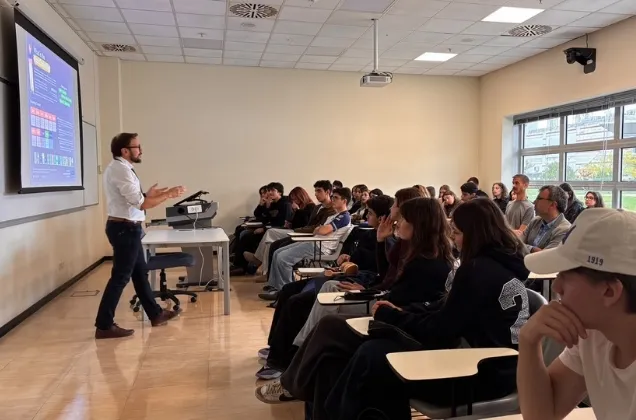
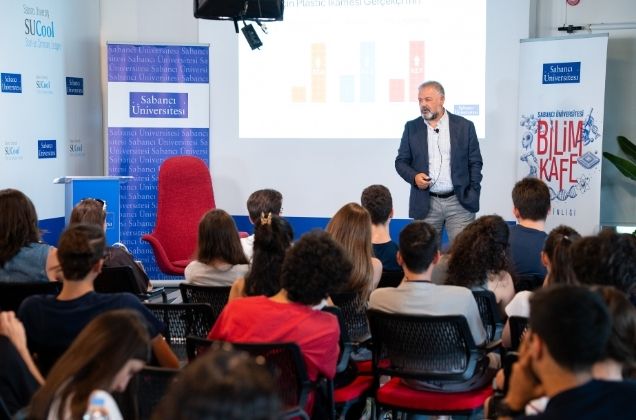
As part of its "Science Cafe" events, Sabancı University hosted students from its High School Summer School. The event, attended by Prof. Dr. Yusuf Menceloğlu, a faculty member in the Materials Science and Nanoengineering Program at Sabancı University, addressed the importance of nanotechnology and its relationship with sustainability.
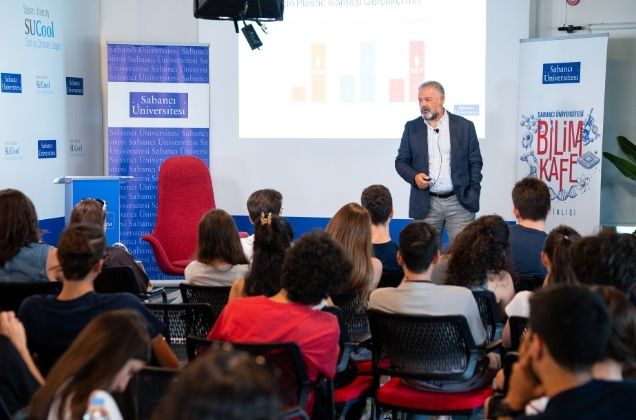
As part of the "Science Cafe" events, initiated last year by the Council of Higher Education (YÖK), students from Sabancı University's High School Summer School's "Entrepreneurship" course met with Prof. Dr. Yusuf Menceloğlu, a faculty member in the Materials Science and Nanoengineering Program at Sabancı University. Prof. Dr. Menceloğlu gave a presentation on "sustainability and nanotechnology" on the university's Tuzla campus.
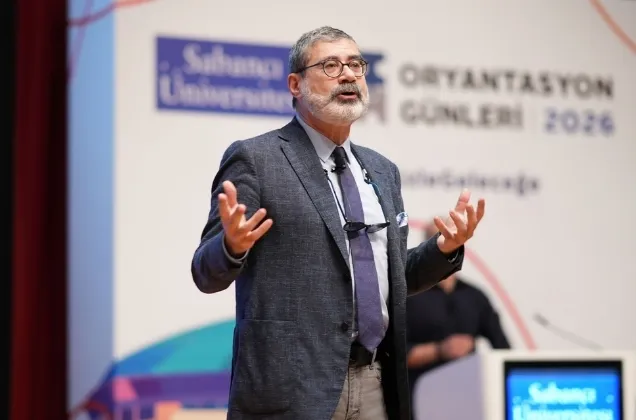
In his presentation titled "New Job Fields in the Context of Future Professions: Sustainability and Nanotechnology," Prof. Dr. Menceloğlu explained how nanotechnology contributes to sustainability. Menceloğlu stated, “The world population increases by 1 billion every 10-15 years. However, while the population increases, water, energy, and agricultural areas do not increase at the same rate. Therefore, sustainable solutions that consider environmental, economic, and social balance together are of great importance in order to meet the needs of the future. Population growth and climate change increase the demand for resources such as water, food, and energy every day, and we must develop technologies that can meet these needs while protecting the environment.”
“It is necessary to develop applications that support natural systems.”
Prof. Dr. Menceloğlu emphasized that the circular economy is a concrete and functional tool that separates resource use from business growth in order to achieve sustainable goals. Menceloğlu stated: “The circular economy is based on three design-oriented principles. The first is to eliminate waste and pollution. Waste is not an error at the end of the system, but an element that must be prevented at the design stage. The second is to recycle products and materials. Materials are kept at their highest value through repair, reuse, renewal, and recycling. The third is to renew nature. Instead of simply "doing less harm," it is necessary to develop practices that support natural systems and increase biodiversity.”
“Nanotechnology offers opportunities to contribute to sustainability”
Prof. Dr. Yusuf Menceloğlu emphasized that nanotechnology plays an important role in sustainability. Menceloğlu stated, “Thanks to materials developed at the nanoscale, it is possible to achieve more effective functions using less material and to develop cost-effective solutions. From plant protection, fertilization, soil improvement, and water treatment applications in agriculture to food packaging, clean water, renewable energy, and waste upcycling, nanotechnology offers significant opportunities to contribute to sustainable development goals in many areas. We are particularly looking at where we can adapt nanotechnology in sustainable agriculture and food. Research is being conducted to transform these technologies into applications that provide solutions to the needs of society. It is possible to develop sustainable solutions in many areas with nanotechnology.”
“A research-based approach is important for solving global problems”
In his speech, Prof. Dr. Menceloğlu also touched upon Sabancı University's research-centered approach. Yusuf Menceloğlu stated, “A research-based approach is crucial for finding solutions to global problems. Problems have changed in the 21st century. Now we have energy problems, waste problems, water problems, and so on. It's impossible to solve these problems with a single discipline. To solve macro problems like climate change, the use of water and energy resources, food security, and population growth, we need tiny systems, or “Nano bio information” systems. This understanding is also reflected in Sabancı University's philosophy. We believe that engineering education should be considered alongside fundamental sciences such as physics, chemistry, mathematics, and biology.”
Encouraging Young People to Think Scientifically
The “Science Cafe” events, one of the important initiatives of the Science Communication Office established by the Council of Higher Education (YÖK), aim to encourage university and high school students to approach the world with scientific curiosity, critical thinking, and a desire for discovery. The platform, where participants can ask experts questions directly, is an important science communication initiative aimed at increasing trust in science and spreading scientific thinking.